Austro-Libertarian Natural Order Philosophy From Indyeah

Individualistic Austro-Libertarian Natural Order Philosophy From Indyeah
Showing posts with label Civil Aviation. Show all posts

Thursday, September 22, 2011

Abolish All State-Owned Enterprise - By Constitutional Law


A good definition of a State-owned enterprise (SOE) is:


A firm with an unlimited capacity to make losses.


We discussed Air India the other day, in which I quoted the following from a news report:


The airline, which is burdened by an accumulated loss of Rs 20,320 crore, has outstanding loans and dues of Rs 67,520 crore -- of which Rs 21,200 crore is working capital loan, Rs 22,000 crore is the long-term loan on fleet acquisition and Rs 4,600 crore vendor dues, latest official figures showed.


Today, the bad news is about BSNL - the State-owned telecom firm - which has now accumulated losses of over 6000 crore rupees (1 crore = 10 million). Its revenues have declined - and its biggest cost is salaries for its 2,77,000-strong workforce. BSNL is opting for a voluntary retirement scheme that will cost the company Rs. 2,700 crore while the Department of Telecom (which means us) will have to shell out Rs. 18,000 crore. 


Overstaffing - the bane of the public sector: "Jobs for the Boys."


What I would like to add today on discussions against SOEs is the fact that they are "unfair competition." If a private telecom firm had made such losses as BSNL, and if its employees numbered so much, it would have folded up long ago. Ditto for Air India. New, private owners would have taken over both these firms. But with SOEs, this never happens. And these loss-makers continue to "compete" with efficient private firms, taking business away from them. Note that the news report above on BSNL says:


BSNL, which offers telecom services in all areas of the country, barring Delhi and Mumbai, had 95.14 million mobile subscribers as of July 31. It is making efforts to catch up with its private counterparts.


That is 95.14 million subscribers "unfairly" taken away from private firms. If BSNSL and Air India had been allowed to fold up, their employees would have found jobs with profit-making private firms - and contributed to national wealth.


Why should there be SOEs at all?


In the old days, like when I was in college studying Economics, we were told that Chacha Nehru set up these State-owned firms because, among other reasons, "private capital was not forthcoming." That is clearly not the case today. In telecom as well as civil aviation, in steel, in hotels, in fertilisers - in everything - private capital is doing wonders. And this is particularly true of telecom and civil aviation, two sectors where SOEs are failing dismally, showing clearly that they "work" only where competition is outlawed - like railways and electricity. This itself shows the inherent inefficiency of SOEs. Ministers and baboons are unfit to run enterprises - and they most certainly should not be allowed to do so with money pulled out from the public treasury.


So, when we have a New Constitution, when we have our Second Republic, let us include a clause that debars The State from funding any SOE.

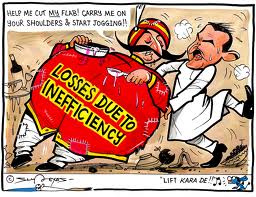
Friday, September 2, 2011

They Are Stealing Our Money At Air India: Take #2


There is news today that our The State is gifting 705 crore rupees to Air India. But the last paragraph of the news report from The Indian Express deserves to be widely read. It reads as follows:


The airline, which is burdened by an accumulated loss of Rs 20,320 crore, has outstanding loans and dues of Rs 67,520 crore -- of which Rs 21,200 crore is working capital loan, Rs 22,000 crore is the long-term loan on fleet acquisition and Rs 4,600 crore vendor dues, latest official figures showed.


THIS IS THEFT!


No Anna Hazare or Lok Pal can stop this.


It requires IDEOLOGICAL correction.


We need to understand why we have ministers and civil servants.


We surely don't need them for running airlines. That too, at a loss.


BTW: I always fly Indigo. Brand new planes. Hundreds of them. Low cost. Always On Time.


And I think: What a great guy - the entrepreneur who has set up Indigo Airlines.


Not only that: We pay HUGE TAXES to fly by Indigo - and still this entrepreneur manages to net a profit.


And look at where our HUGE TAXES go.


I compare the entrepreneur who set up Indigo Airlines with Rajiv Gandhi - who flew his mother's State-owned planes.


Get my drift, buggers?

Friday, June 10, 2011

Lessons From The Juggernaut

Man Friday took me to the shop selling ganja just opposite the Juggernaut Temple. The chariot was under construction; hundreds of carpenters working. It is the worship of The Wheel - and wheels were denied Indians during the Nehru-Indira Gandhi years. Even now, inefficient wheels rule. After all, our king rides a donkey - the Ambassador. The Sun Temple at Konarak is also about The Wheel - as the photo alongside shows.

Transportation is of key importance to trade - which is why coastal regions have always prospered. In India, transport sucks. Productivity is measured in Time. Poor transportation reduces the productivity of us all. Shubh Yatra should go with Shubh Laabh - and that requires The Wheel.

Of course, now we have wings - but I just read that IATA has placed our The State in the "Hall of Shame" for overtaxing civil aviation. I could easily have flown down here - but the taxes were more than the fare. These morons are anti-progress. And they are running Air-India! And Air India is taking passengers away from legitimate commercial airlines - "unfair competition."

Spent a lazy evening on the beach. No shacks here selling cold beer and interestingly named cocktails. Only little tea shops. Tiny little ones. I pointed out that so much sweet tea is being consumed by our people - and tea is something new, something the British introduced. They introduced tobacco too, and coffee. All these are legit - but the ganja of the ancients is illegal.

Baba Ramdev talks about "black money" - and the ganja-charas trade today must be all about Black Money. If it was legit, customers would be legally served and a bonafide industry would emerge. I found a kiosk in Bhubaneswar where the guy sells ready-made joints. These should be machine made - in big factories. 

Legalise it!!!

Don't criticise it!

I'll advertise it!

But the woman running the tea stall on the beach managed to get me a beer. 

What I would like to ask is the question "Why?" Why do people accept these restrictions on trade, on peaceful exchange, on ways to keep the customer happy without hurting anyone. Why are we so servile?

And why does The State suppress and oppress us so?

Why are there so many laws, rules and regulations?

What is the point of voting for an MP who goes to Delhi to pass more laws - while there is no one to run The City?

And all the villagers are moving to cities.

And our The State is pursuing "rural development."

The System is Wrong. 

Friday, January 21, 2011

Sick, Sicker, Sickest

Air India is "sick" in the sense that it has accumulated losses of Rs. 5000 crore (50 billion). But the politicians who run it want more and more money put in - and this money is to come from our The State, which is itself in serious deficit. Sick State running sick companies. Our "common loss." 

Praful Patel of the NCP, the minister for civil aviation on whom I have a previous post, has been promoted in the cabinet reshuffle of yesterday. He is now minister for heavy industries and public enterprises - and, in his first public statement on taking charge, has insisted that "Air India should not be declared sick." He wants our The State to pour more cash into Air India. He thinks it can be restored to good financial health - by the new minister in charge of civil aviation. Praful Patel will now have 100 or so other "sick" public enterprises to run - and we can be sure that he will demand bailouts from the Treasury for them all. This is what the CONgress calls "socialism": politicians and bureaucrats running businesses. Since the very idea is sick, all these businesses are sick.

Vayalar Ravi, a CONgress trade unionist from Kerala, is the new minister for civil aviation. In this interview, he says Air India will be his "top priority," and that he wants to bring back its "lost glory." Actually, this short-lived glory of Air India occurred because of private management - because JRD Tata, a "pioneer aviator" himself, looked after its affairs personally. Under State ownership, ministers come and go, each seeking short-term personal gains. Just as the nationalisation of Air India was "legal plunder," State ownership and management of the airline is more and more plunder. Sick idea. Sick company. Sick ministers.

Air India - and all the other PSUs - are neither capitalism nor socialism; they are "cronyism." Every single person involved in them, from minister to peon, is a crony of The State. They are not allies in business; they are allies in plunder. They give credence to Murray Rothbard's dictum: "The State is a gang of thieves writ large." They make me sick.

I watched Vayalar Ravi on television last night, being interviewed by Vikram Chandra of NDTV. As the minister went on and on mouthing socialist inanities, Chandra went on and on expressing complete agreement. Indeed, Chandra addressed the minister as "Sir" - that too, at least fifteen times in two minutes. His prime time show is called "The Big Fight." But when it comes to ministers, he doesn't fight at all. This "crony journalism" is what I find sicker. Our media is full of it.

And now - the sickest: the "crony academic."

Pratap Bhanu Mehta is a former professor of philosophy, law and governance at Jawaharlal Nehru University. Now, he chairs The Centre for Policy Research, a State-owned so-called "think-tank." He is a long-time columnist of The Indian Express - and his column today is on "food security." He writes, in his opening paragraph:

It is a scandal that after two decades of high growth, India still does not make adequate nutrition available to large sections of the population. There is simply no financial, technological or production related reason why this should be so. 

So, just as Praful Patel and Vayalar Ravi think that there is an inexhaustible fund they can tap to fund all their socialist schemes, Mehta too sees no financial constraints to obtaining "food security." We can safely assume that he is a Keynesian funny money man - and he must be so, because Wikipedia says he was "educated" at Oxford and Princeton - in philosophy, politics and economics. Ben Bernanke is also from Princeton, a long time chairman of their Economics department (see my old post on his academic credentials). Paul Krugman, the Keynesian Nobel laureate in Economics, is from Princeton too.

Mehta, the Keynesian funny money man who recognises no financial constraints facing The State, thus makes the case for "universalisation" of his food security scheme. He also looks favourably at the possibility of "cash transfers" - all the cash being more funny money, of course. So, when faced with the inevitable consequence of inflation, he displays the real motive behind this column: the desire to sow the seeds of confusion in public opinion, to poison the air. He writes:

The arguments over the causes of inflation — supply bottlenecks, currency policy, global trends, monetary policy, weather, hoarding, speculative investment, deficit spending — no longer serve analytical clarity. They have become contrivances to avoid the core issue: there is a serious governance deficit that will stymie both public and private provisioning.

Mehta's column is titled "A platter of blather." The above is nothing but blather. Pure blather. Every Keynesian knows that money supply increases cause a rise in all prices: the "quantity theory of money." This is the basis of all their "monetary policy."

However, midway through his piece, Mehta, former professor of philosophy, law and governance at JNU, asks two questions:


What the hell CAN government do? Why does it even exist?


 Well, the government exists because of the Constitution. 

And, since government is nothing but force - compulsion, coercion and legislation employed by tax-collectors, cops, judges, jailors and executioners - to all sensible people it makes eminent sense to direct this force very carefully. The bigger the role of The State, the greater the use of force. Thus, to keep Air India and all the loss-making PSUs afloat, force will be applied: taxation. So too with Mehta's "universal food security." Thus, it is our socialist Constitution that is the root of all evil. It has unleashed upon us an "unlimited State." Unlimited taxation, unlimited borrowing, unlimited funny money, unlimited interventionism. That is, unlimited tyranny. Unlimited plunder.

Mehta finds the absence of food security a "scandal." To me, on the other hand, our unsafe streets on which 200,000 pedestrians and cyclists are killed every year is the real "insecurity scandal." I find it a scandal that the Supreme Court has said the "criminal justice system is not working." Of course, all this "infusion" of public finds into loss-making PSUs like Air India is also a scandal - as is all the funny money being printed to fund all this shit.

"What the hell CAN government do?" asks Mehta. Well, one thing it can do very well is plunder.

So let us think of a Constitution of India framed by people like Professor Pratap Bhanu Mehta. It will surely proceed like this:

WE, THE PEOPLE OF INDIA, having solemnly resolved to constitute India into a SOVEREIGN, SOCIALIST, SECULAR, DEMOCRATIC REPUBLIC and to secure to all its citizens:

FOOD - the government is to ensure universal provision of food,

PROFIT - the government is to run all businesses,

WORK - the government is to employ us all,

EDUCATION - the government is to cultivate our minds,

MONEY - the government is to produce all the money our society needs,

CREDIT - the government is to provide all of us credit, and that too, at very low rates of interest,

HOUSING - the government will ensure all of us are well housed,

SOBRIETY - the government is to ensure none are high,

TIMELY REST - the government is to ensure all establishments close at a decent hour, thereby playing Wee Willie Winkie to us all,

UNSEXINESS - the government is to prohibit anything and everything that makes us horny,

etc. etc....

IN OUR CONSTITUENT ASSEMBLY this twenty first day of January, 2011, do HEREBY ADOPT, ENACT AND GIVE TO OURSELVES THIS CONSTITUTION.

Sounds crazy? Or does it sound sick?

Then, what the fuck is the reason why governments are created?

One answer: To secure our lives, our properties, and to thereby ensure our LIBERTY.

And it is precisely these that are not happening. We are dying on the streets, our properties are not secure, and we possess no liberty at all.

Think about it.

Wednesday, December 8, 2010

More Scams - And Some Questions


Yet another huge scam has hit the news! This is about UP during 2004 - 2007, while Mulayam was chief minister. Some 35,000 - 2,00,000 crore (1 crore = 10 million) rupees worth of grain (estimates vary) meant for the poor were stolen by State functionaries.

Makes you realise that this "right to food" business is part of our "right to fraud."

Think about it - the huge involvement of our The State in foodgrain: first, they buy up foodgrain at high "support prices" from (rich) farmers; then they store this grain, usually in the open, under plastic sheets; then they transport this grain (now depleted by rats) to government shops all over the vast landmass; then they pretend to sell this grain cheap to the poor... but then, the grain often gets stolen on the way.

All this costs them so much that they have to print money to pay for it.

This causes inflation.

Wouldn't the poor be better off if traders sold them grain? - just as they do all other things, from vegetables and fruit, milk, meat and fish, spices, cloth, mobile phones....

As Bastiat said, socialism is all about "false philanthropy."

I wonder what Bastiat would think about the second piece of news I found - that our The State is pumping in Rs. 1200 crore rupees into Air India next week. This cannot be philanthropy - for the poor do not use Air India. I, for my part, would prefer to call it "loot."

Of course, if Air India was sold off, and civil aviation de-regulated, the poor would benefit - and more poor people would fly. I discussed this the other day.

The Lesson: Socialist politicians can never help the poor via The State. They only help themselves. They end up screwing up State budgets - and this leads to higher taxation, higher borrowing, quantitative easing - and inflation. Private investments fall. Thus, if we want the poor to climb out of poverty, we must put an end to all this "false philanthropy." Let private investments grow - so the poor get jobs. Let there be competitive markets and free trade - so the consumption of the poor improves. Let there be Liberty and Property - so the poor can raise Capital and become entrepreneurs themselves. All solutions to poverty lie in The Market. The State is the primary cause of impoverishment.

This lesson is drummed home by this slideshow I found today - on the miserable condition of the finances of the government of communist West Bengal, a government that hates business and loves to throw money at the poor. West Bengal is the most indebted state of the so-called Indian federation: its debt burden stands at a staggering 2,00,000 crore rupees (1 crore = 10 million). Of whatever revenue it extracts from its poor people, this government spends 97 per cent of this on interest payments on past debt and salaries of present employees. How is this colossal debt ever going to be repaid? How many future generations of Bengalis will be burdened with this debt?

There are an entire host of state governments that are completely broke. UP, Bihar, Orissa, Maharashtra - these are all deep in debt. On the extreme, there are many state governments that depend entirely on Central funds - Kashmir, Manipur, Chhatisgarh, Jharkhand, Nagaland, Tripura.

And as for the Central State - in this year's Budget, they announced plans to borrow Rs. 3,50,000 crore rupees.

Not one paisa of this huge amount of money (which will eventually have to repaid by us, and our descendants) will be "invested." All of this will be "consumed." Rich, poor, middle-class - all will be hurt.

Now, ain't it kinda strange that the man at the top is supposedly an "economist"?

But then, is he a "politician"?

Has he been "democratically elected"? Yet, he is into his Second Term!

Lots of questions to ask ourselves, in this lootocracy.

Sunday, December 5, 2010

They Don't Really Care About Us


While scandals on government corruption never seem to end, it has been useful for the personnel of our The State to find an excuse to point to private-sector "greed" - and thereby portray themselves as our "protectors" from that greed.

The case in point is about our new private airlines. There isn't a single Indian who would prefer a return to the days of State monopoly over domestic civil aviation. Yet, because of the fact that some of their "spot fares" - that is, on tickets booked shortly before departure - seem too high, our minister for civil aviation, Praful Patel of the NCP, has been making some very strange noises. According to this news report, the minister is "setting up an economic advisory council, which will meet on 10 December to discuss what are reasonable fares." In the same report, the minister makes this claim in support of his interventionism: "We are here to help the sector to grow while keeping in mind interest of the passenger."

For one, the huge taxes being levied on air travel disprove this grandiose claim. These taxes are, in fact, screwing the passenger. They keep our unsafe railways afloat - who deserve to be out-competed.

Second - the ministry continues to bar the entry of new players. The only answer to high fares is competition. That is, the only counter to one company's greed is the greed of other companies. The greedy State will only make things worse.

Third - in the field of civil aviation, our The State is very much a greedy player. This minister runs Air India and Indian Airlines, and their various off-shoots. Because their losses are covered by the taxpayer, these State-owned airlines offer "unfair competition" to their private sector rivals. In a free market, they would have folded up long ago.

Thus, the passenger-taxpayer is being doubly screwed. The State must therefore exit civil aviation completely. Thereafter, the sector must be completely de-regulated. Only then can the "interest of the passenger" be served. Indeed, the poor Indian passenger would then probably be served a drink after take-off - something our The State prohibits today. Triply screwed!

The most inspiring story of de-regulation of civil aviation comes from the US. They used to have a Civil Aeronautics Board (CAB) that not only regulated fares, but also awarded routes. Market principles did not work at all - and political graft ruled the roost. Anthony Sampson's history of the early years of civil aviation Empires of the Sky: The Politics, Contests and Cartels of World Airlines (1985) noted that, with the CAB, airlines had a "murky relationship with the US President."

Then, in 1977, along came Jimmy Carter with different ideas. He installed Alfred Kahn, an economist, as head of CAB. Kahn did the unthinkable: he de-regulated the CAB out of existence! No more CAB! This "father of airline de-regulation," as he is now known, brought into being a host of "low cost carriers" - like People Express and Southwest Airlines. Kahn inspired Europe - and the Thatcher era saw Freddie Laker taking on the "Big Five" with his SkyTrain across the Atlantic. The rest is history.

We in India need an Alfred Kahn - not this NCP man, Praful Patel, with his double-speak.

Praful Patel hails from a political family - his father was a prominent CONgressman. His constituency lies in Gondia, in the poor Vidarbha region of Maharashtra. He is also big in business - a sort of "bidi king." These business interests have since diversified - into pharmaceuticals, real estate and packaging. This apart, he also runs the "Gondia Education Society" that, according to his profile on the party website, "imparts education to 80,000 students in all disciplines ranging from Arts, Commerce, Engineering, Law, Pharmacy, Information Technology, and Computer Sciences."

According to Wikipedia, Praful Patel is "a former Director of Jet Airways."

Methinks we need an Alfred Kahn.

Tuesday, September 29, 2009

Air India... And A Historic Opportunity

True to form, our Chacha State keeps moving from crisis to crisis – the latest being the pilots’ strike at Air India. The state-owned airlines' annual losses exceed Rs. 7500 crores and its borrowings are over 15,000 crores. That is, in a market economy such a firm would have closed down long ago. Other, more efficient, airlines would have taken its place.

However, under State-ownership, this company of losers is allowed to remain in operation and, what is more, “compete” with efficient private players.

How can anyone compete with a firm whose losses are underwritten by The State? In reality, Air India has been “outcompeted” long ago. The private airlines have won the battle ages ago. However, the losing party keeps coming back into the fray with taxpayer support.

This is “unfair competition.”

There is a case made out for legal action – and the decision should apply to all PSUs: that they inject unfair competition into markets.

I witnessed this raw power of loss-making transport PSUs in Mangalore, when the State-owned bus company announced the deployment of 50 additional buses on a busy inter-city route. This set the cat among the pigeons of the private bus operators. They had to “lobby” hard to get rid of this unfair competition. In effect, they were blackmailed by a loser.

Ditto for Air India announcing tomorrow that it will run 50 low-cost Mumbai-Delhi flights a day.

No one will be able to compete.

And, instead of encouraging enterprising businessmen, our society will be encouraging tax parasites.

I suggest legal action at the Competition Commission. Indeed, if I recall right, the commission is empowered to take up such issues suo moto. It should do so.

This crisis of The Chacha State can then be turned into a historic opportunity to get rid of the entire public industrial sector. Total privatization. The entire proceeds, which represents the “commonwealth,” should be invested in a world class, pan-India, toll-free roads system. This means additional taxation will not be required for the purpose.

But look at the matter in any way you like, you will arrive at the same result:

=> How can a private school compete with a “free” government school?

=> How can the steel industry be competitive if the loss-maker SAIL dominates the market?

The conclusion to draw is “when the king trades, the people become beggars” – an old Gujarati proverb, I am told.

I leave you with this thought:

“A government does not exist to conduct the affairs of men. It exists to administer justice among men who conduct their own affairs.”


It is time to get rid of The Total Chacha State.

Thursday, September 10, 2009

Against Trade Unionism

The pilots’ strike at Jet Airways is hogging the editorial pages today. And this gives me an opportunity to discuss what libertarians think of trade unions, and their most potent weapon – the strike. Or, what occurs more often, the strike threat.

In the first place, it must be noted that trade unions and their methods can never raise the wages of workers in general. They raise wages in particular areas only, for certain chosen workers who belong to the combination – while keeping the rest of the workers excluded. They are therefore promoters of particular interests alone; they are against the general interest.

What galls libertarians most is that trade unions are legally authorized to use force – against workers, against the management, against workers who break the strike. According to libertarian philosophy, no one should be allowed to use force in markets. Further, there is no reason to believe that a free market for labour is not in the best interests of the entire working class. Trade unionists are a labour elite who represent a privileged constituency of labour. They should never be seen as truly representative of workers as a “class.”

Let us examine the libertarian view on trade unionism in the light of the present strike by Jet Airways’ pilots:

At the root of things lies the “contract” between every individual Jet Airways pilot and his employers. Since every pilot has signed such an individual contract with the company, they are all individually bound to deliver their services as per contract. The pilot can demand pay as per contract; and the company can demand work as per the same contract.

Today, it is the pilots who are violating their individual contracts and not delivering work as they should. This is against Law as commonly understood. It was therefore not surprising to hear that, within 24 hours of the strike, both the Left parties and the BJP “had come in support of the strike and the right of the pilots to form a union.” They want to inject politics into everything; they want to politicize a purely legal matter relating to the enforcement of contracts.

I read three editorials on the pilots’ strike today: The ToI is the most illiberal, supporting “collective bargaining” on the one hand and yet trying to oppose the strike; the Express contrasts the cabin crew with the privileged pilots; while Mint goes the whole hog and asks whether all our labour legislation is outdated.

I think it is Mint that has hit the nail on the head. At the core of the issue is the matter of legislation – and the privileges thereby conferred to unions. This is something that began in the West – and has ruined the West. Let us dump this as we try and build a new, competitive India.

What would airline pilots do without unions? Why, they would simply join which ever airline paid more. That is, their wages would be determined by market forces, not politics. And that would be in the best interests of all, including ALL pilots.

Recommended reading: The works of WH Hutt. In particular, The Theory of Collective Bargaining, available here. After reading this, go to The Strike Threat System: The Economic Consequences of Collective Bargaining, available here.

Monday, September 7, 2009

India's Magna Carta Moment Arrives

Let us be completely dispassionate, and only resort to cold reason – for the news today requires sober reflection.

First, from the west, Gujarat, comes the news that a magisterial inquiry has concluded that the Gujarat Police murdered four young people in cold blood. Here is a news report; here is a video story.

The conclusion:

Our The State is violating our Right to Life.

This is a serious charge indeed.

Let us now turn to the east, where, from Calcutta, comes the news that the prestigious Rajarhat IT Park is being cancelled because the land was being illegally “acquired.” For whom: Well, the usual suspects, Infosys, Wipro etc.

The conclusion:

Our The State is violating our Right to Property.


This, too, is a very serious charge.

In Gujarat, the ruling political ideology is that of a “majority community”: the individual, the minority, matter little.

In Bengal, the ruling political ideology is of a “collective” – and here too the individual, and most certainly his property, matter none at all.

Bad ideas have consequences.

We must instead think of catallaxies, of individuals, of strangers, exchanging goods and services freely, under the laws of private property, contracts and torts - laws which arose among the people themselves, and do not require legislation. This is the world of "private law."

Note that in both the top stories in the news today - from the west and from the east - of murder and misappropriation - it is The State that is breaking The Law.

We are therefore at a critical moment in constitutional history – when The State has to be placed under law. This law, of course, being Several Private Property, beginning with one’s body, one’s life, and what one produces or homesteads.

Such law is the only solution to the problem of social order, given the fact that the one institution with a monopoly on force – The State – is violating law.

It is this The State that must be placed under a law that it did not legislate.

Cold reason therefore indicates that India has reached a critical point: the choice between collectivism and individualism, the choice between private property and collective property – like Air India, of course.

They have just put 5000 crores down that hole.

This too is a violation of Property: for these are public revenues being stolen.

Once again, this is a dereliction of “democratic” responsibility – for the idea is to “represent” the taxpayer: these guys represent tax parasites.

And Air India will “compete” with private low-cost airlines. Read Captain Gopinath’s excellent piece on the fabulous prospects of the civil aviation sector in India, prospects which are dimming because of our The State, and its baby, Air India.

5000 crores for Air India? You could build an elevated ring road around Delhi with that money, I think. What a senseless The State. Every action galls.

What galls me most, of course, is that these guys control “education.”

I remain optimistic, because I see the country waking up slowly to another principle by which to conduct its common affairs, one based on the inviolability of private property.

Liberty Under Law.

More importantly, The State Under The Same Law.

Magna Carta time, my fellow citizens.

Sunday, August 30, 2009

When Morons Teach...

There is news that Air India is to open an aviation academy in Shillong. What a bloody joke! This State-owned colossal loss-maker is a disgrace – its losses exceed 16,000 crore rupees; it has just received 5000 crores from The State; and it is also heavily in debt. What can such an airline teach?

One thing we Indians have learnt the hard way is that enterprise must be “private”; that there is no such thing called “public enterprise.” Air India was one of the world’s leading airlines when JRD Tata, a pioneer aviator himself, was at the helm. Today, with sarkaari baboons running the flop show, it is a shame. It is a drain on the nation’s wealth. Not only that, as I had recently blogged, it injects unfair competition into a sector where many private players have entered. These private players have given the customer a good deal. Air India, on the other hand, is a very bad deal – for the customer, and also for the nation. It should be sold. Period.

The news also says that the chief minister of Meghalaya is to “give” 12 acres of land to Air India for their academy. I think this land can be much better utilized in a thousand different ways.

The lesson: Don’t get a moron to set up an academy and teach. The people will only learn rubbish.

This lesson is driven home by a brief column in Mint today that talks about land titles. The point the authors make is that India’s land title system is in total disarray. They argue in favour of a strong property rights regime, including title insurance. Without such a system, India can never become a great piece of real estate.

Of course, Chacha Manmohan S Gandhi is spending 150,000 crores on a system of ID cards. He is not particularly bothered about property rights or land titles.

But he too wants to teach.

I hope you have learnt an important lesson today.

Friday, August 7, 2009

Staring At Our Socialist Doom

Today, the ToI has reported on Lalgarh, and this is big news: The rebels held and armed rally yesterday. Thousands were in attendance.

Now, this is a purely “government” problem. It has nothing to do with occupying the “commanding heights of the economy” – and it is here, on basic issues of civil government, that our The State is clueless.

Not that they are doing too well on the economic front either: the news is that Air India is 16,000 crore rupees in debt (100 crores is a billion). Of this, 11,000 crores is “high cost debt.” The managing director of Air India told the press that he plans to turn the company around in 3 years, mainly by entering the low cost domestic aviation market.

This is totally unethical. The government cannot enter into “competition” with the citizenry, who are operating many private low cost airlines. This cannot be the “Role of the State.” And anyway, no one can compete with an entity that can accumulate unlimited losses and still operate. It is like a loss making State bus company “competing” with private bus operators (read earlier post).

Thus, whether on matters related to the nitty gritty of civil government – like maintaining the peace or keeping land records – or on economic issues, we are forced to conclude that our socialist Chacha Manmohan State is clueless. This is stark evidence of the deep errors in socialist thinking.

And they want to teach.

By force!

Where are we headed?

Thanks to LRC, here is a cartoon-based essay on the differences between the pessimism of Aldous Huxley and that of George Orwell. Both saw doomsday ahead – but there were vital differences, which this very well illustrated essay brings out.

And then you decide: Where are we headed? Which doomsday are we looking at?

Friday, July 31, 2009

The 3Ts Of Prosperity... All Destroyed!

It is indeed disheartening to hear of the plight of our new private airline companies. They have decided to observe a one-day token strike on August 18. And they want some sort of “bailout” from our The State – and somewhere here I kinda tuned off. This is a disaster.

Note that Air India has just asked for a 20,000 crore rupee bailout.

Transportation is the key. This is another disaster in transportation.

Our The State monopolizes roads and railways – and a flourishing private sector in civil aviation was bound to alter the rules of the game. It is my firm belief that our The State deliberately played spoilsport in order to keep its railways in business. This is precisely the kind of ideas that guide the actions of a “predatory state.” The taxes and other fees added to the airfare are extortionist. They invariably add up to more than the airfare itself! It is as if they do not want more and more Indians – who have never flown – to fly. The “evil eye.”

India desperately needs a Revolution in Transportation. We now have cars; we need highways. On the coast, we need modern boats. In the mountains we need modern cable cars. And we need airways too.

If excellent highways are built, and if good policies guide the growth of private airlines, the railways will be outcompeted: for distances up to 1000 km people will take a modern bus on a modern highway; beyond that, they’ll fly. Only then will our State-owned railways be forced to get its act together. Transport is always “multi-modal” – and all the modes compete.

But that is the India I daydream about.

The harsh reality is that we are moving in precisely the opposite direction – towards a Total Transportation Disaster.

In the capital city, New Delhi, the authorities have assumed that the Metro rail is a substitute for roads; a substitute for cars. They do not think “multi-modal.” They have never heard the saying “every great city sits like a giant spider on its transportation network.” That “all roads led to Rome.” They do not see that the road layout of Connaught Place and the Lutyens’ Bungalow Zone, where they live, is a “hubs-and-spokes” design. The rest of the city, which they laid out, is on the pattern of T-junctions.

Methinks our Central Planners know zilch about Transportation precisely because the “theory” in their heads has nothing to do with either Trade or Towns. Their theory is about self-sufficient village economies. This theory is wrong.

In reality, Trade, Towns and Transportation are the 3Ts of Prosperity.

And these guys have screwed up all three.

Thursday, July 16, 2009

On Thatcher, Chacha And Air India

As a low-cost civil aviation enthusiast, I still recall the times in which this idea was born: the Thatcher era, with Freddie Laker taking on the “Big Five” - BOAC, KLM, Pan Am, Air France and Lufthansa - on the busy London-New York route, with his "skytrain." It was a thrilling moment. Freddie Laker was one of Margaret Thatcher’s favourite businessmen. She liked the swashbuckling type of adventurer who takes on big competition head on and emerges successful.

Let us now turn to the evil designs of the Chacha Manmohan State and the curious case of Air India entering the domestic low-cost airline business. What does this mean in terms of realpolitik? Allow me to illustrate by means of an incident I was witness to.

During my Mangalore years, something I found clearly noticeable on the streets was a vibrant private bus industry. As a champion of private business, I welcomed this. However, all these private bus owners here are forced to compete with KSRTC – the Karnataka State-owned bus behemoth. This KSRTC (like Air India) runs at a loss. Now, try imaging competing with someone who can afford to run at a loss, year after year.

Anyway, one morning I read the news that KSRTC was launching 50 new buses on the Mangalore-Udipi route, a very busy 50 km stretch of NH 17, on which you can get a private bus every 5 minutes. Which is why none take the train.

The announcement of 50 new KSRTC buses on this route created a big fear among the private bus operators. In the end, their view prevailed, KSRTC withdrew, but not after much lobbying, during which, or so it was alleged, many crores changed hands. I was also told that these bus operators had bought off the Indian Railways – because of their lobbying, the Bangalore-Mangalore rail link had never been constructed!

Note that all this corruption and bribery is rooted in the evil idea that The State should occupy the “commanding heights of the economy.” In a free market, the commanding heights are occupied by consumers. And “civil government” is always an ancillary to The Market. These are the ideas that should be at the foundation of the Second Indian Republic.

Getting back to civil aviation: Try and picture the scene. Some four or five new private sector low-cost and full service airlines have come up – and become the toast of the town. They have redefined flying in India, making it immensely affordable. There has been a dramatic increase in the number of first time fliers. This is progress – because of private enterprise. In the old days when State-owned Indian Airlines monopolised the market, we all took the train. Delhi-Goa on Indian Airlines cost more than Delhi-London on Pan Am.

Yet, unlike Margaret Thatcher, who encouraged Freddie Laker, Chacha’s State has actually worked against these pioneering businessmen. There is onerous taxation; there is the high cost of aviation fuel, monopolistically supplied by The State. There have been some mergers. These businesses are not yet completely out of the woods. And yet, at such a moment of time, Chacha is going to let the loss making Air India “compete” with these truly heroic private businessmen.

I condemn this idea as evil in intent, and against the “common profit of the realm.”

Air India should be sold – lock, stock and barrel.

Ditto for the KSRTC.